
Kentucky VINE Custody Coverage
Kentucky VINE stands for Victim Information and Notification Everyday. It is a free automated service for custody status and notifications. The state says its data comes from jails, prisons, mental-health facilities, and juvenile detention. Public access must still respect any limits on juvenile or restricted records. VINELink is the web interface used to choose Kentucky, find a specific offender record, and request notices.
VINE is a notification layer. The legal source remains the agency that holds or released the person. A county-jail feed concerns that local custody record. A KDOC feed concerns state corrections custody or supervision. If a person drops from a current jail roster, the change could mean release, transfer, or movement to another authority. Read the named event and facility before drawing a conclusion.
The official Kentucky VINE information page describes statewide coverage and registration choices.
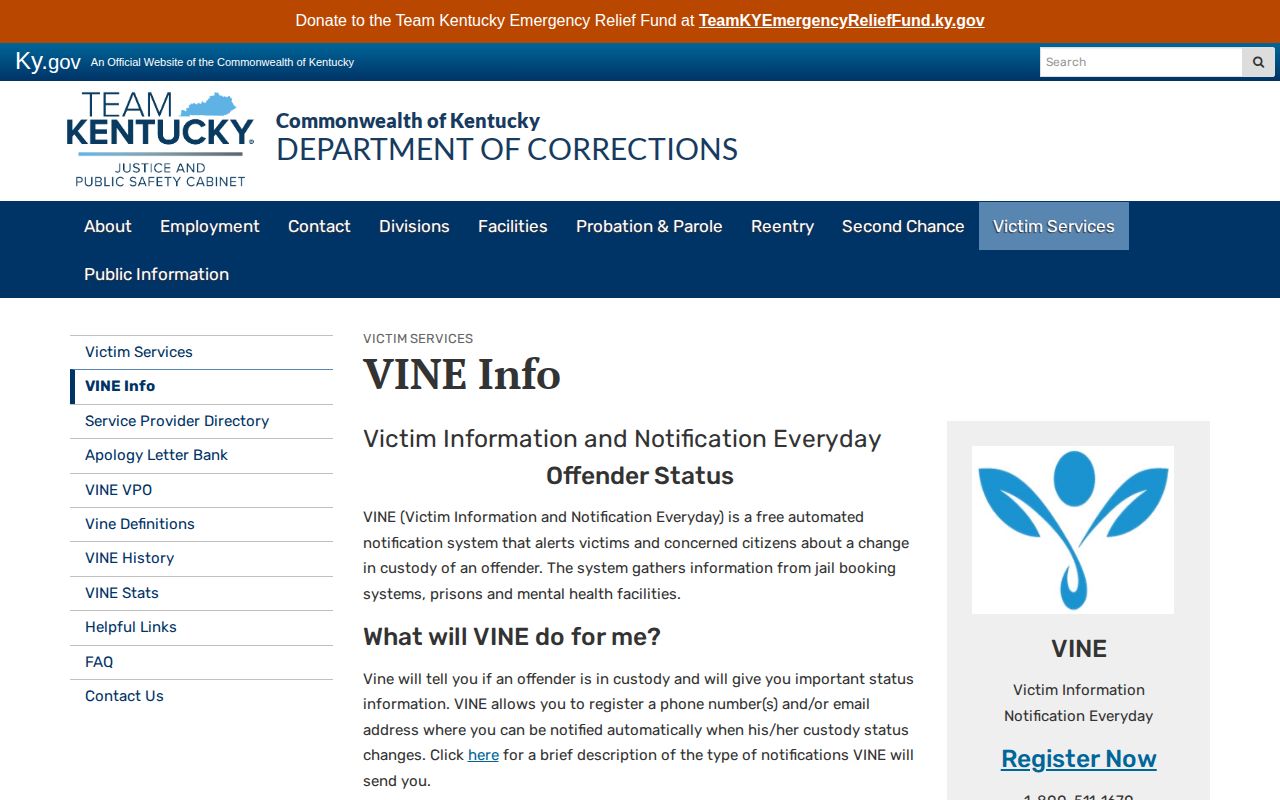
The state page also gives the telephone enrollment route for people who do not register through VINELink.
Run a Kentucky VINELink Check
Begin with enough facts to separate people who share a name. A partial name or a jail or DOC identifier can be searched. When the result list contains more than one record, compare the ID, reporting facility, status, and other available details. Do not choose a record only because the name looks close.
- Open VINELink and choose Kentucky as the service area.
- Select “Find an Offender” rather than a court-case option.
- Enter a partial name or the known jail or DOC identifier.
- Open the best match and compare the record with known custody facts.
- Read the current status, location, and exact event wording.
- Use “Notify Me of Status Changes” only after confirming the match.
The VINELink offender-check screen provides the Kentucky search and “Notify Me” flow.
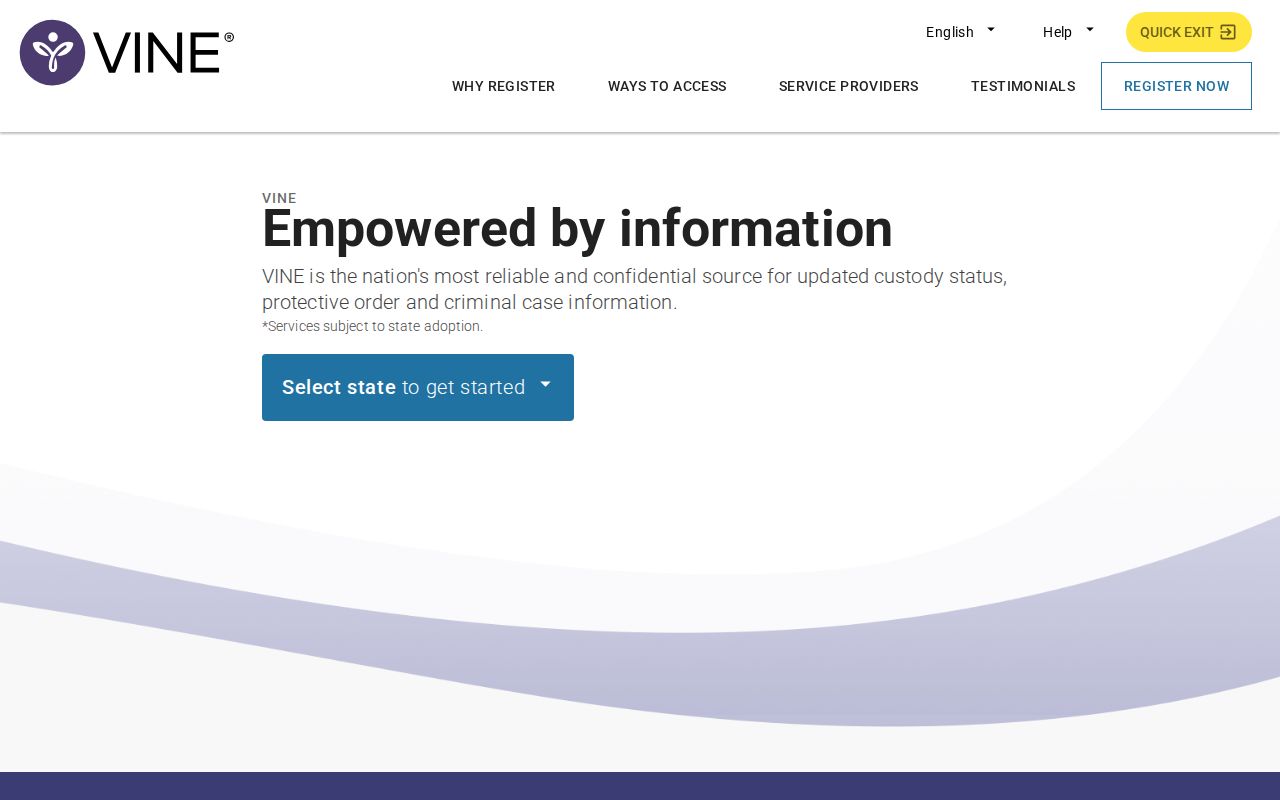
Save the identifier and facility shown on the matched result so the later alert can be tied back to the same record.
Note: If the last facility is unknown, the County Directory can route a local custody question to the likely Kentucky locality.
Kentucky VINE Release Fields
The fields and event labels depend on the record source. A state corrections entry and a local jail entry for the same person may not display the same event at the same time. Treat the record as a report from its named custodian rather than as a universal statewide case file.
| Field or event | What it shows |
|---|---|
| Name and offender ID | The identifiers used to distinguish the selected custody record. |
| Custody status | The current state reported by that participating agency. |
| Facility or location | The jail, prison, or other source tied to the record. |
| DOC Advanced Release | A scheduled release within 14 days of sentence end, not an actual-release notice. |
| DOC Parole Eligibility | Expected Parole Board consideration within 120 days. |
| DOC Parole Notification | The state says release on parole occurred. |
| Other release events | Wording may identify court order, home incarceration, shock probation, or another defined route. |
Do not flatten “advanced release,” “parole eligibility,” and “parole notification” into one generic release date. The first two announce an approaching milestone. The third reports that parole release occurred. Other events can reflect release by court order, home incarceration, shock probation, or sex-offender post-incarceration supervision. The Kentucky VINE event definitions supply the controlling descriptions.
Register Kentucky Release Alerts
After the right record is open, select “Notify Me of Status Changes” and follow the prompts. Kentucky permits more than one phone number or email address. Telephone enrollment can also be completed through 1-800-511-1670. Registration is anonymous from the offender, but the contact channel must work with the service. A switchboard number cannot be used.
- Confirm the offender ID and reporting facility before registering.
- Select the status-change notification option on the matched record.
- Add the desired phone numbers or email addresses.
- Create the four-digit PIN used to acknowledge automated calls.
- Complete the confirmation prompts and retain the registration details.
- When an alert arrives, verify it with the named custodian.
For telephone alerts, VINE may leave a message and continue calling during a 24-hour period until the call is acknowledged with the PIN. The PIN confirms receipt. It does not unlock a custody record or change the person's status. Keep it private so another person cannot acknowledge calls unintentionally.
Two Kentucky VINE Records
Kentucky warns that one state offender may have both a DOC VINE record and a local-jail VINE record. The state advises registering on both. This can occur when a person is housed in a county facility while connected to a KDOC sentence or movement. Each source can generate a different event because each reports its own part of custody.
This dual-registration rule is a Kentucky-specific safeguard. A local entry might reflect departure from a jail bed, while the DOC entry continues to show state custody, supervision, or another KDOC status. Conversely, the state record may report a parole or sentence event while the local record reflects the physical facility movement. Registering for both reduces the chance that one authority's update will be mistaken for the whole story.
After an alert, match it to the source record. If the notice says transfer, locate the receiving authority. If it says parole, compare the KDOC supervision status. If it reports a court-ordered release, obtain the court record or the facility movement entry when the exact legal basis or time matters.
The safest registration plan begins with the person's last known physical location and legal custody authority. A jail name identifies a local feed. A DOC or PID number points toward the state record. When both exist, keep the registration confirmations separate and note which identifier belongs to each. If only one alert arrives, check the other record before assuming its silence means no change. Different update times can produce a gap between the local movement and the state status.
Kentucky VINEcourt Has Ended
KDOC states that Kentucky no longer provides VINEcourt. Users cannot create new court-case registrations or receive notifications on existing court-case registrations through that service. Custody notifications continue. This limit makes VINE a custody tool, not a statewide docket or case-disposition service.
A Kentucky court order may explain why a person left custody through bond, dismissal, probation, or shock probation. Those trial-court records must be requested from the Office of Circuit Court Clerk in the county that handled the matter. Kentucky does not offer one open public statewide trial-disposition search that replaces this clerk route. VINE can report the custody event, but it cannot supply every court document behind it.
During 2025, Enhanced VINE recorded 4,546,894 offender searches, 606,865 notifications, and 196,588 new registrations. These figures measure service use. They are not counts of unique people, unique releases, or active court cases. The Kentucky VINE statistics page is also the official source for the VINEcourt limitation.
Note: Continued custody alerts do not restore court-case alerts; use the county circuit clerk for the trial-court record.
Confirm a Kentucky State Release
When the record concerns a state prisoner, use the Kentucky Department of Corrections system to confirm the broader status. KOOL, the Kentucky Offender Online Lookup, can show an Active Inmate location or community labels such as Parole, Mandatory Reentry Supervision, Probation (Regular), Probation (Shock), and Pre-Trial Diversion. It may also show supervision dates and a Probation and Parole district.
A P&P district is a community-supervision office, not a prison. “Released To Other Agency (Probation & Parole)” documents departure from imprisonment into that arrangement. It does not prove final discharge. KOOL also warns about freshness, and KDOC makes no fixed public promise that every fully discharged historical offender will remain searchable forever. A missing result must not be treated as proof of no past custody or complete legal discharge.
The official KOOL gateway explains its accuracy and update cautions.
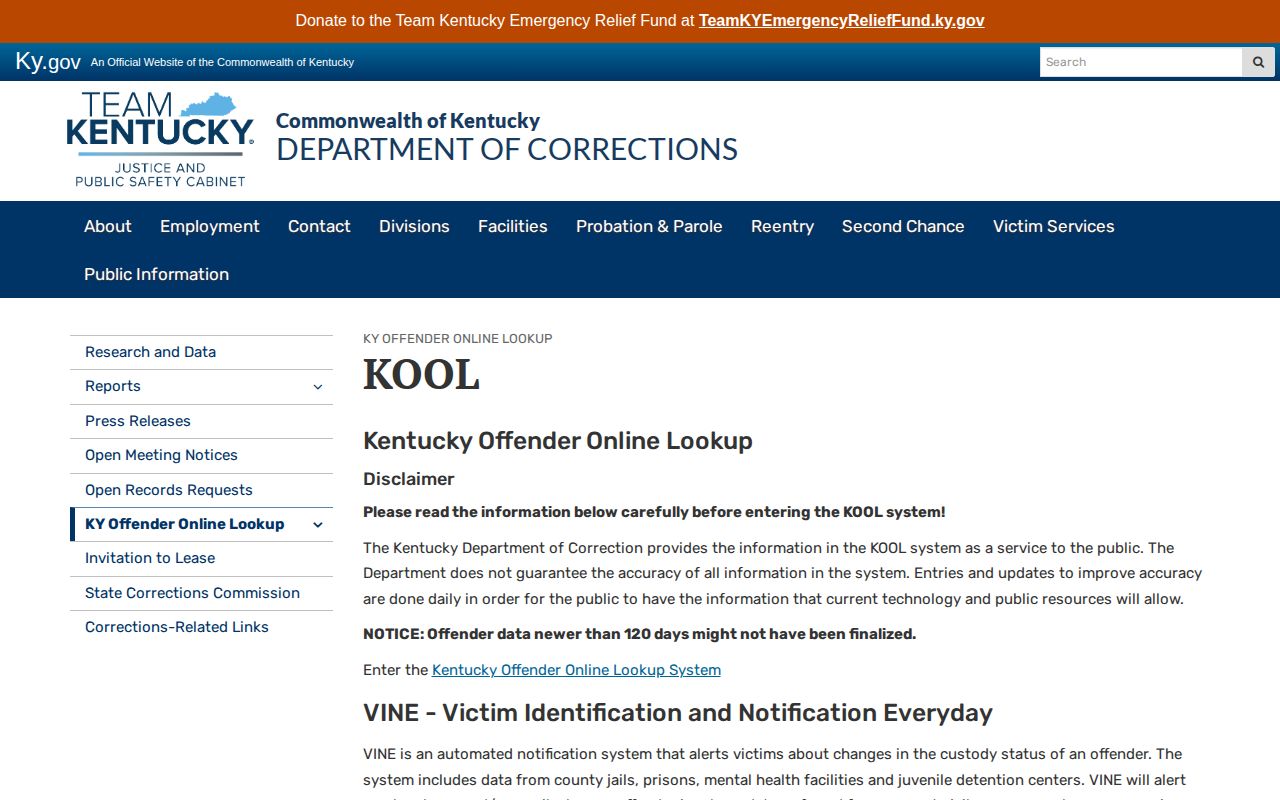
Match identifiers in the KDOC offender search, read present status first, and use a dated release report or records request when exact movement is disputed.
Federal Inmates Are Outside VINE
VINELink is not the source for a person in federal Bureau of Prisons custody. Use the BOP locator, which covers federal inmates from 1982 forward and accepts a federal number or a name. A BOP register number follows the format five digits, a hyphen, and three digits. BOP says “RELEASED,” or a past release date with no facility, means the person is no longer in BOP custody. It does not rule out federal supervision or state, local, ICE, or other custody.
The official federal inmate locator is the correct search for BOP records.
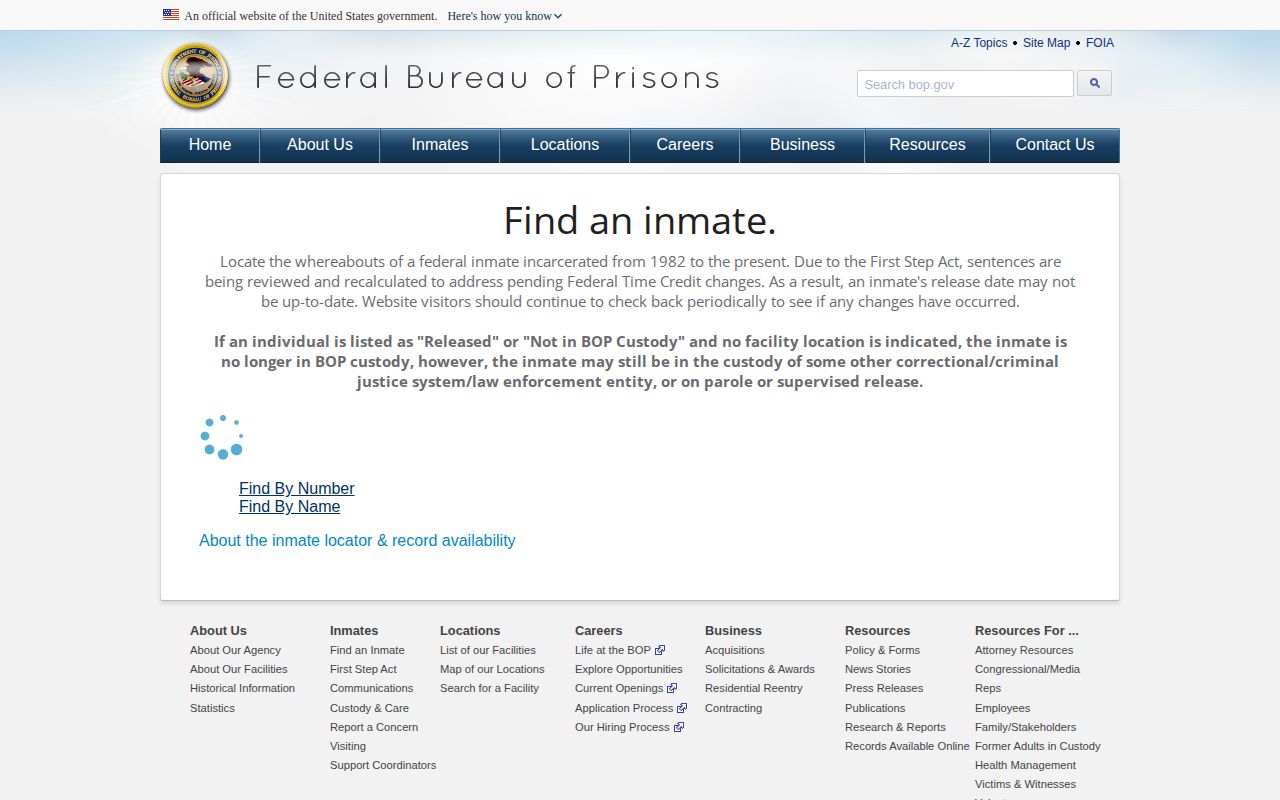
A future BOP release date is projected and may change, including after sentence or First Step Act recalculation.
ICE uses a different locator for current immigration detention or a person held by CBP more than 48 hours. A no-result there is not universal proof of release. Federal and immigration systems do not turn a Kentucky VINE alert into a federal release record, and a federal “released” result does not prove the person has no other custody or supervision.
Verify Kentucky VINE Events
Start with the authority named in the alert. For a county jail, ask the local custodian for the release or movement entry. For KDOC, match KOOL, check the Daily Releases archive around the likely date, and request the movement or release record if exact timing matters. For a court-ordered event, obtain the order from the county circuit clerk. Each source answers a different part of the release.
A current roster mainly answers who is in that facility now. A person who left may no longer appear. That absence does not identify whether the person went home, entered supervision, transferred to another jail, moved into state or federal custody, or went to another authority. VINE is useful because it can announce a named event, yet data entry and transmission can lag.
- Custody alert
- An automated notice that a participating source reported a status change.
- Actual release
- The completed departure from the reporting custodian under a stated authority.
- Transfer
- Departure from one custodian into another authority's control.
- Discharge
- A legal endpoint that may occur well after release into supervision.
The strongest finding joins the alert to the matching agency record. Keep the event words, date, offender ID, and source facility. Then confirm through the custodian that owns the underlying record.
For a recent local release, ask for the facility's existing release or movement entry and identify the approximate date. For a state-sentence release, KDOC records can separate the actual movement from projected dates and parole milestones. When the VINE event points to another agency, continue with that agency's locator or records office. A transfer closes one custody segment without proving return to the community.
Time also changes what a search can prove. A fresh alert may lead to a current status that has not yet synchronized across all systems. An old no-result may reflect record coverage rather than the absence of any past case. Write down when each search was run and preserve the exact label. That small record makes later comparison much clearer and avoids turning a changing status into a permanent claim.
Public Record Search
Sponsored Results