
Kentucky Projected and Actual Release
A projected date estimates a future sentence milestone from information held by the Kentucky Department of Corrections. An actual release date records an event that has already occurred. Those two ideas must stay separate. A future minimum-expiration date can move after a disciplinary decision, sentence correction, new court order, or detainer. A proposed parole date can also fail to become an exit if required placement is not approved or the parole certificate is not signed. Even a completed Kentucky release transaction may transfer the person to another agency rather than place the person in the community.
Custody level matters first. A pretrial detainee is waiting on court action and usually has no sentence-based projected release date. Bond, dismissal, a plea, a court order, or transfer may determine that person's next move. A sentenced person in a county jail may have a locally computed term, while a state-sentenced person housed in a jail may still have a KDOC-controlled calculation. Federal dates belong to the Bureau of Prisons. One date cannot safely be carried from one authority into another.
Read Kentucky Projected Release Fields
Kentucky Offender Online Lookup, commonly called KOOL, separates calculations that are often mistaken for one release date. The advanced form includes a Projected Release Date From/To range, which helps narrow a search. A detail record can then display several different milestones. Read the exact field name before using its date, because each answers a different question.
| KOOL field | What it means |
|---|---|
| Expected Time To Serve (TTS) | A KDOC sentence calculation shown on some active detail records. |
| Minimum Expiration of Sentence Date | The displayed good-time release calculation, subject to the governing credit rules and later changes. |
| Parole Eligibility Date | A point when parole consideration may become available, not a grant or release. |
| Maximum Expiration of Sentence Date | The outside sentence-expiration milestone shown by KDOC. |
| Proposed Release Date | A date in the parole table tied to Board action and remaining release steps. |
The official KOOL gateway also explains that information is supplied for public access and carries freshness and accuracy limits.
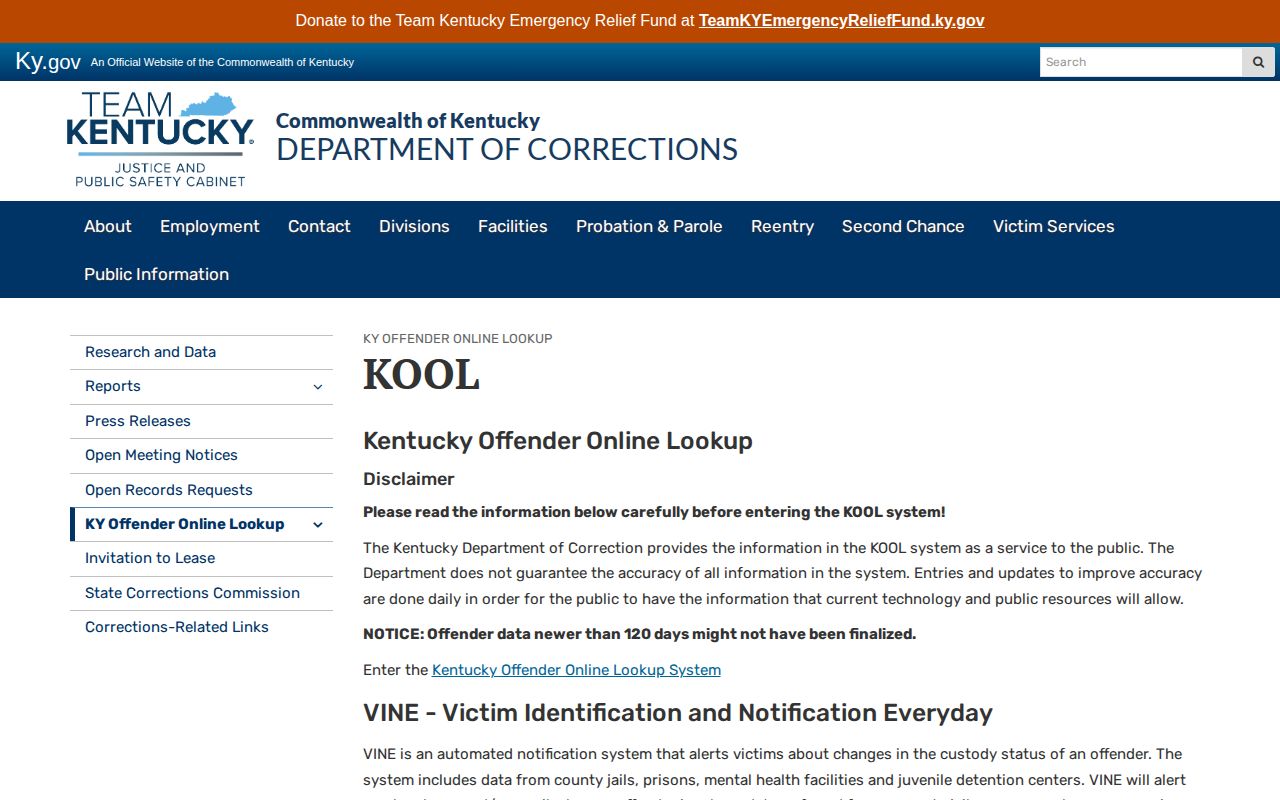
That warning is a reason to record the search time, verify identifiers, and corroborate a disputed Kentucky release date with the agency record.
Find a Kentucky Projected Release Date
Start with the last known custodian. KOOL is the right statewide route for a KDOC case, but it is not a complete archive of every county arrest or local misdemeanor term. A person who appears only in a county jail system may need a local records check and the court order from the county that handled the case. A missing live-roster entry is not enough to show release, since transfer to KDOC, another jail, federal custody, or another authority can also remove the person.
- Open the official KOOL search and begin broadly with a surname and first initial. Too many filters can hide a valid match.
- Match the person by PID or DOC number, aliases, physical details, conviction county, offense dates, and photograph when present. Do not rely on name alone.
- Read current status and location before reading future dates. An active prison or jail location still means custody.
- Compare Expected TTS, minimum expiration, parole eligibility, maximum expiration, and any proposed parole date without merging them.
- Check for a detainer, another agency, a parole action, or a community-supervision label that changes what the date represents.
- After the expected day, compare current KOOL status with the dated KDOC release report and request the movement record if precision matters.
For a county-held person, use the Kentucky County Directory to reach the locality tied to the facility. Ask for an existing release or movement entry and the sentence calculation rather than asking staff to create a new legal explanation. The court record may show the order that authorized bond, probation, shock probation, dismissal, or a sentence change, while the custody record shows when the person physically left.
Why Kentucky Has Several Release Dates
Kentucky's date labels reflect different parts of the sentence and release process. The Projected Release Date search range helps locate records by a future window. Expected TTS and minimum expiration concern sentence calculation. Parole eligibility marks possible consideration, while a proposed parole release follows Board action. Maximum expiration is yet another endpoint. None, standing alone, proves that a person walked out of the facility on that date.
This distinction is especially important when parole and sentence credits overlap. A person may become eligible for parole and still remain confined. Another person may be denied discretionary parole but later leave under a different lawful route. A minimum date may also arrive while a detainer sends the person to another custodian. Kentucky release research is strongest when the field name, current status, releasing facility, and actual dated event all agree.
Mandatory Reentry Supervision adds another Kentucky-specific distinction. Current KRS 439.3406 generally provides a supervised release six months before projected completion for a qualifying person who was not granted discretionary parole, subject to the statute's listed exclusions. MRS is treated as release on parole for its legal operation, yet it is not a discretionary Board grant. A proposed parole date and an MRS date can therefore reflect different routes. If KOOL later shows Mandatory Reentry Supervision, report that label and its supervision dates rather than saying the Board granted parole.
The Kentucky Parole Board schedule shows upcoming hearings and eligibility lists, not confirmed departures.
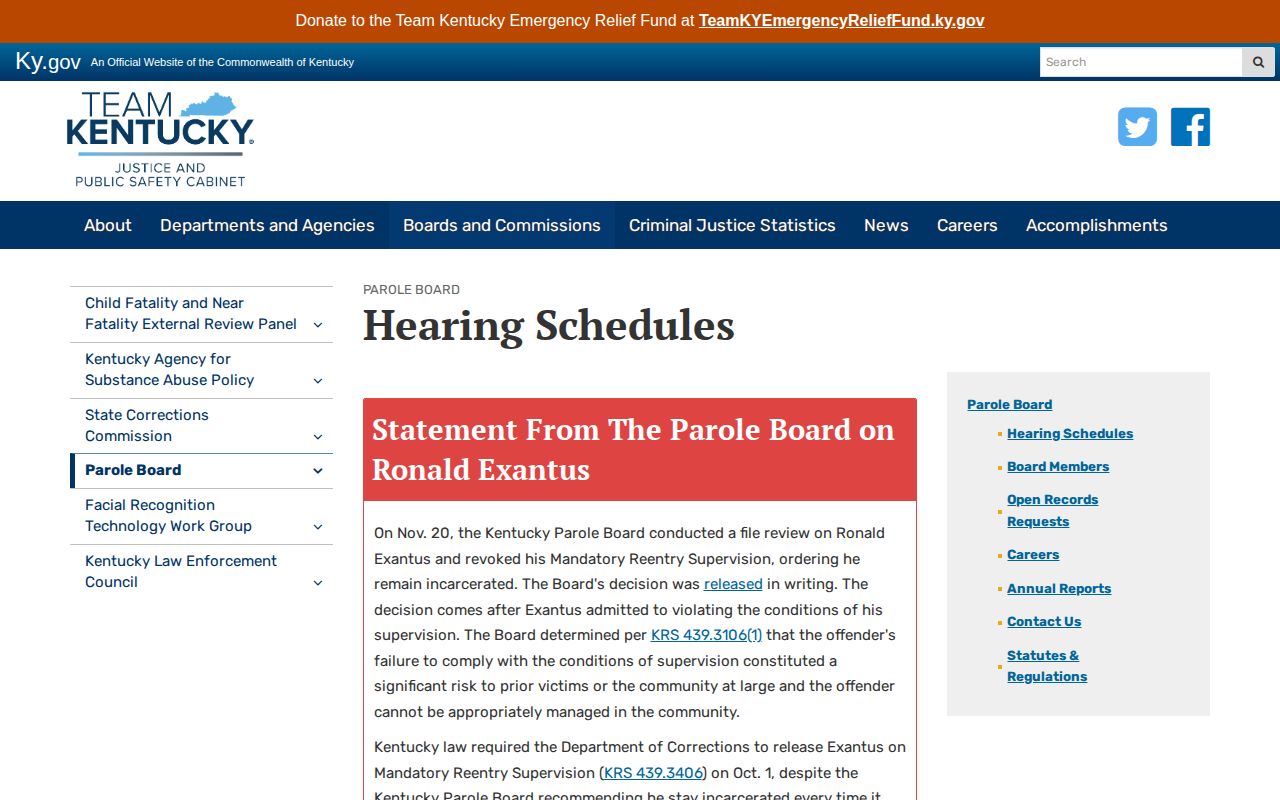
A schedule entry means review is approaching. The Board action, signed certificate, and custody record determine what followed.
Note: A hearing may occur before the eligibility date, so the calendar date should never be recast as a Kentucky release date.
Kentucky Sentence Credits and Release
KRS 197.045 governs important Kentucky sentence credits. It includes credit for prior confinement and specified credits tied to approved education, treatment, evidence-based, promising-practice, or life-skills programs. The law also permits discretionary credit of up to ten days per month for good behavior and up to seven days per month for meritorious or emergency service awarded by the commissioner. “Up to” matters. The maximum is not an automatic monthly award.
| Credit or rule | Effect on the calculation |
|---|---|
| Prior confinement | Credits qualifying time already spent confined under the governing sentence law. |
| Approved education | KRS 197.045 provides 90 days for an approved diploma, degree, or technical-education completion. |
| Approved programs | Up to 90 days may apply for each qualifying treatment, practice, or life-skills program. |
| Good behavior | The commissioner may award up to ten days per month; it is discretionary and not guaranteed. |
| Meritorious or emergency service | The commissioner may award up to seven days per month under the statute. |
| Forfeiture or earning limits | Rule violations or offenses can cost credits or restrict future earning, apart from prior-confinement credit. |
Consecutive sentences aggregate for credit computation. The statute also contains special restrictions, including rules connected to sex-offender treatment. KDOC, not an outside estimate, applies the sentence facts and credit history. The displayed minimum-expiration field is therefore more useful than arithmetic based only on a sentence length, yet it remains a future calculation until release occurs.
Kentucky Violent-Offender Release Limits
Current KRS 439.3401, effective July 15, 2026, places a major truth-in-sentencing limit on covered violent offenders. A term-of-years violent offender generally must serve at least 85 percent before probation, shock probation, parole, conditional discharge, or another early-release route. Covered life, capital, and Class A cases generally require at least 20 years. The statute specifies categories and exceptions, so neither rule should be applied from an offense name alone.
Offense date and legal classification can change which text applies. Older Kentucky materials may cite former versions or statute pages. The current law must be read with the judgment and KDOC calculation. For a covered violent-offender sentence, credits do not turn the 85 percent threshold into a promise of release at that point. Eligibility and release are distinct, and the person's status remains the first field to check.
What Moves Kentucky Release Dates
A Kentucky inmate projected release date can move in either direction. Some changes alter the sentence calculation itself. Others leave a Kentucky sentence milestone intact but change where the person goes. The key is to identify which authority made the change and whether the result concerns eligibility, a planned release, or completed physical movement.
| Factor | Possible result |
|---|---|
| Credit award or recalculation | The minimum-expiration calculation may move when qualifying credit is posted. |
| Discipline or forfeiture | Loss of eligible credit can move the projected date later. |
| Court action | An amended sentence, new case, shock probation order, or other ruling can alter the path. |
| Parole action | Grant, denial, deferment, rescission, or serve-out changes the parole route without rewriting every sentence field. |
| Detainer or hold | KDOC custody may end through transfer to another authority rather than community release. |
| New status information | A recent record may change as agency data is reviewed and finalized. |
KDOC says KOOL updates four times a day but warns that information newer than 120 days may not be finalized. That is a freshness warning, not a fixed retention rule. If two fields conflict, preserve their labels and dates, then ask for the underlying sentence-computation or movement record. Do not choose the earlier date simply because it seems more favorable.
Verify a Kentucky Actual Release
Once the suspected date passes, use evidence of the completed event. KDOC's Daily Releases archive identifies actual dated KDOC-controlled releases, including the person, release type, and released-from location. It does not cover each county bond-out, dismissal, misdemeanor time-served release, or local transfer. A local event still belongs with the county custodian and the court that issued the order.
The KDOC Daily Releases archive provides dated reports for checking whether a projected state release became a recorded event.
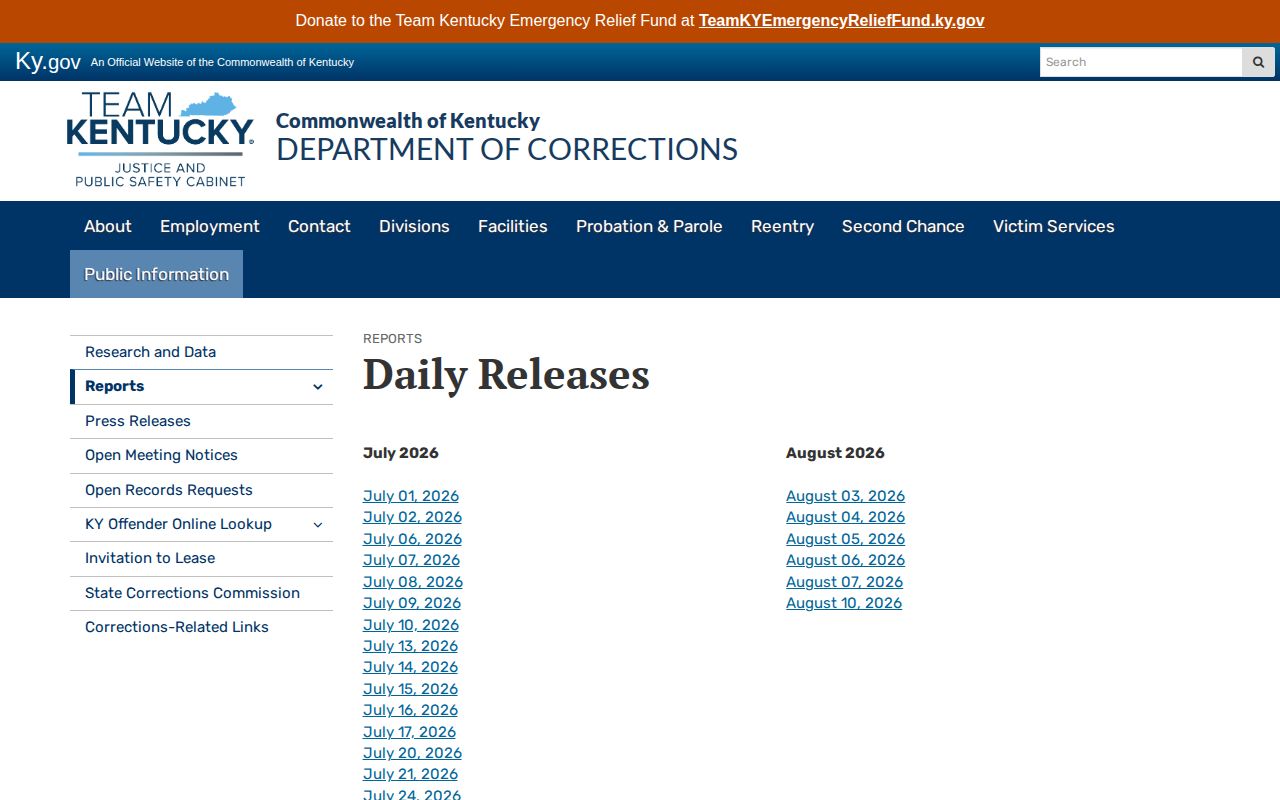
A matching line is stronger evidence of KDOC departure than a past future-date field, but the listed release type still must be read for transfer, supervision, or other-agency context.
Use two sources when the exact outcome matters. Match the dated report to the current KOOL record, then check the receiving authority if the release type points elsewhere. A status such as Parole or Mandatory Reentry Supervision shows release from imprisonment into supervision, not final discharge from every obligation. A live prison or jail status remains evidence of custody even if an older projected date has passed.
Request Kentucky Release Calculations
A records request is the fallback for an older case, a missing result, or a conflict that public fields do not resolve. KDOC requires a written request. Include the full name plus date of birth or offender ID, a mailing address, the facility, and an approximate date range. Ask for existing records such as the sentence-computation sheet, release or movement entry, actual date and type, released-from location, receiving agency where releasable, and supervision begin or end record.
The KDOC open-records page gives the official email, mail, fax, copy charges, and response framework.
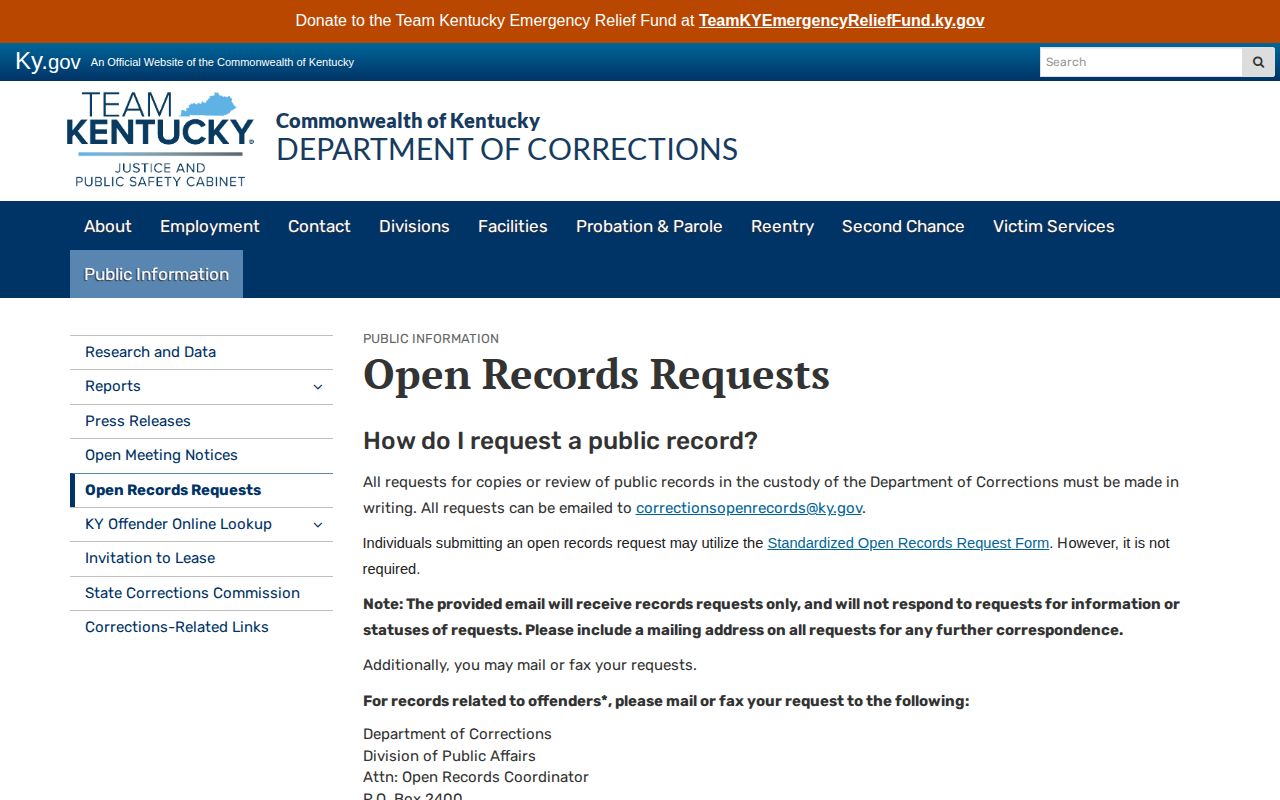
Its form is optional, but the request itself must be written and precise enough for the custodian to identify the existing Kentucky record.
Requests may be emailed to correctionsopenrecords@ky.gov with a mailing address, mailed to the Division of Public Affairs at PO Box 2400 in Frankfort, or faxed to 502-564-9575. KDOC lists ten cents per released paper page, one dollar for a CD plus postage, and about two dollars and fifty cents for a USB plus postage. It states a five-business-day response period under KRS 197.025. That law also carries corrections-security and offender-record limits, so not every requested detail is automatically released.
Note: Ask for the computation and movement entries by name; an open-records custodian is not required to create a new projected-date analysis.