
KDOC Released Inmate Scope
The Kentucky Department of Corrections uses the official abbreviation KDOC. Its Kentucky Offender Online Lookup, known as KOOL, is a corrections database rather than a universal arrest archive. It is strongest when the person served a state sentence, has a DOC or PID number, or entered KDOC community supervision. A local misdemeanor, pretrial stay, bond-out, dismissal, or short county sentence may never create the kind of state record that KOOL searches.
KDOC released inmates can remain visible under statuses such as Parole, Mandatory Reentry Supervision, Probation (Regular), Probation (Shock), or Pre-Trial Diversion. A numbered Probation and Parole district in the location field means community supervision through that district. It is not confinement in an office. By contrast, “Active Inmate” paired with a prison or county jail indicates custody. The status and location should be read before any projected date.
The official KOOL gateway identifies the statewide service and displays its data qualifications.
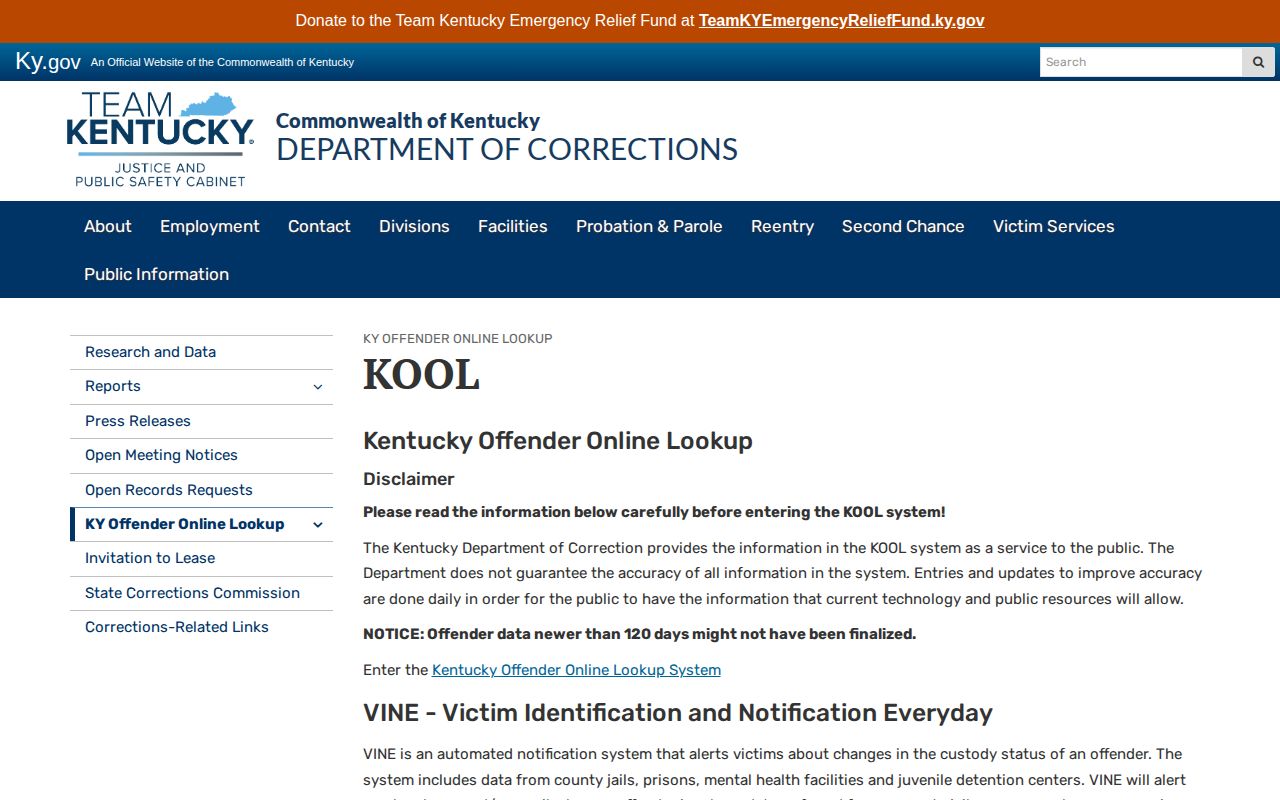
This gateway is the correct first stop for a state corrections record, while the last county facility remains the right lead for a local-only case.
Use the KDOC Offender Search
KDOC recommends starting with broad terms, such as surname and first initial. Adding too many fields can suppress a match. KOOL accepts names and aliases, offender type, DOC and PID numbers, supervision status, location type, specific location, supervision county, age, race, gender, offense, KRS code, conviction and crime dates, institution start, supervision begin, escape or abscond dates, and a Projected Release Date range. Search results show name, present location, PID and DOC identifiers, broad offense-count categories, and a photo indicator.
- Open KOOL and begin with a surname and first initial or a known DOC or PID number.
- Open a likely detail record instead of relying on the summary row.
- Match identifiers, aliases, physical description, photograph where present, conviction county, and offense dates.
- Read current status and location before reviewing sentence calculations or parole dates.
- Compare an actual KDOC exit with the Daily Releases report and request the movement entry if details conflict.
The offense-count groups on a result are only summaries. Read the conviction details before drawing a conclusion. Record when the search was run and preserve the exact terms shown, since a current status can change and recent material may still be finalized.
Freshness and historical reach are different issues. KDOC says KOOL updates four times each day, yet warns that information newer than 120 days may not be finalized. That warning does not say records vanish on day 121. KDOC also gives no fixed public retention promise for every fully discharged person. Its FAQ says only the latest ten convictions appear and sends inquiries about people incarcerated years ago to Offender Information Services at PO Box 2400, Frankfort, Kentucky 40602-2400. A recent conflict calls for an agency record; an old no-result does not prove that no incarceration occurred.
KDOC Offender Search Release Fields
A KOOL detail can place several dates on the same profile. Their labels are not synonyms. Institution Start Date describes entry into the institution period. Expected Time To Serve, minimum expiration based on good time, parole eligibility, maximum expiration, and a proposed parole release each answer a different question. The parole-information table may also show a hearing date, hearing action, months deferred, and next eligibility date.
| Field | What it shows |
|---|---|
| PID and DOC number | State identifiers used to match the correct person |
| Status and location | Custody, community supervision, or another recorded placement |
| Supervision begin and end | The listed supervision span, not a final-discharge certificate |
| Expected TTS | A sentence calculation labeled expected time to serve |
| Minimum expiration | KDOC's displayed good-time release calculation |
| Parole eligibility | When Board consideration may arise, not a grant |
| Maximum expiration | The sentence endpoint shown in the calculation fields |
| Proposed release date | A parole-table proposal, not proof of physical departure |
A phrase such as “Released To Other Agency (Probation & Parole)” establishes departure from imprisonment into the named supervision arrangement. It does not prove sentence completion. Actual release is better corroborated with KDOC's dated report or movement entry.
Verify a KDOC Inmate Release
The Daily Releases archive adds a dated record of KDOC-controlled events. Its reports identify the person, release type, and released-from location. That makes the archive useful when a KOOL profile contains several future or calculation dates. Search the reports around the likely day, then compare identity and location. This method does not reach every county bond, local dismissal, misdemeanor time-served exit, or local transfer because those events may sit wholly outside KDOC.
The KDOC Daily Releases page holds the actual dated report archive.
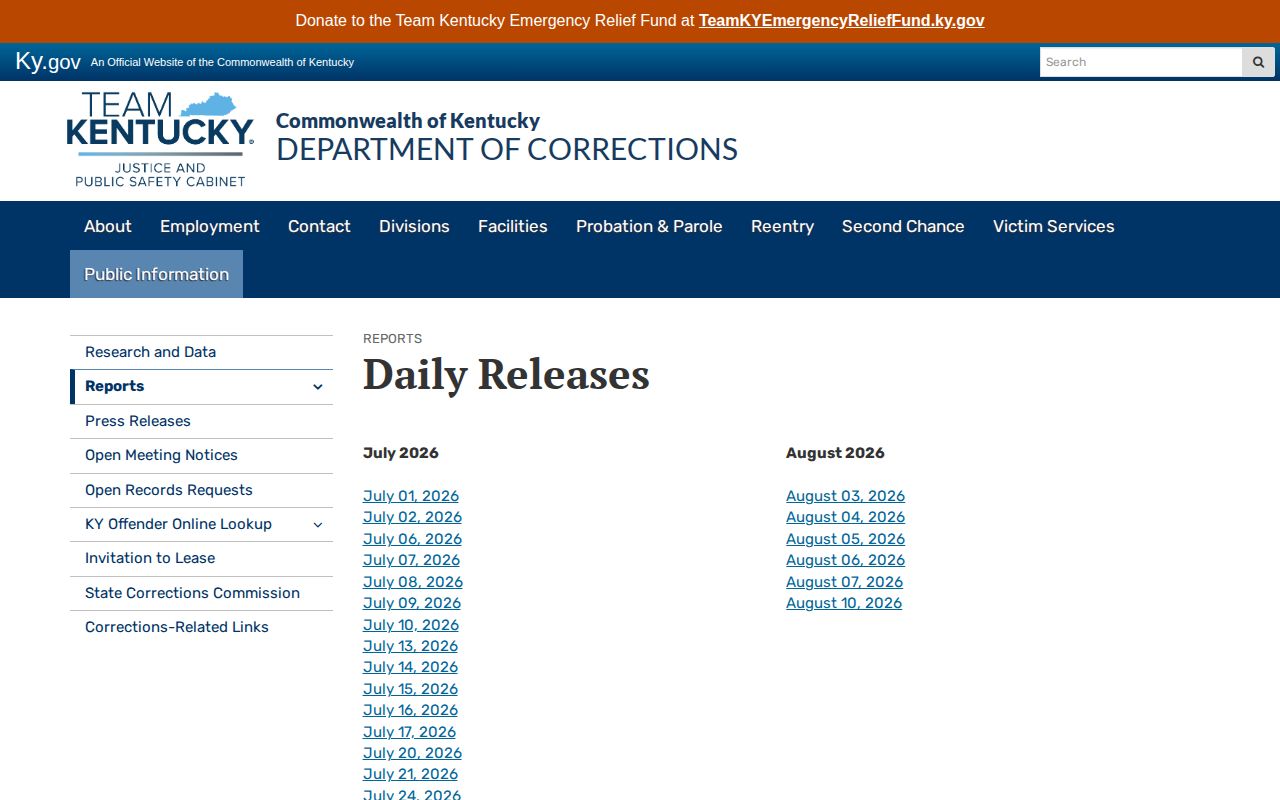
A matching daily report supports an actual state event, but a detainer or transfer label may mean another authority received the person.
Detainers apply across parole, administrative release, and sentence expiration. Kentucky law permits parole to another jurisdiction's detainer while Kentucky retains jurisdiction, and KDOC policy addresses delivery to a detaining authority at expiration. The receiving agency must be checked separately. Community release should never be inferred from the word “released” without reading the destination.
Release check: Match the person, read status and location, confirm the dated event, then identify any receiving agency before treating the result as community release.
KDOC Release and Discharge Paths
Discretionary parole under KRS 439.340 allows the Kentucky Parole Board to release eligible state prisoners and sentenced felons held in county jails under stated conditions. Parole is not a sentence reduction, pardon, or clemency. A recommendation is still short of release. Placement must be approved, the parole certificate signed, and the person must physically leave. The Board can rescind its action before departure.
Mandatory Reentry Supervision follows KRS 439.3406. It generally directs a qualifying inmate who was not granted discretionary parole into supervised release six months before projected sentence completion, subject to the listed exclusions. MRS is legally treated as release on parole and usually ends at minimum expiration, yet it is not a discretionary Board grant. A parole denial and a later MRS release can therefore both be accurate.
Administrative or end-of-sentence release is another path. Posted KDOC policy CPP 25.10 defines an administrative release date around the month containing minimum expiration, with weekend, holiday, disciplinary, noninstitutional, and detainer rules. Current regulatory filings should be checked before treating every policy detail as fixed. Final discharge is later still. KRS 439.354 allows Board action after satisfactory parole performance, and KRS 439.356 gives the resulting certificate legal effect.
Sentence credits affect calculations but should not be recomputed from the public page. KRS 197.045 includes mandatory credits for prior confinement and certain approved education or program completions, plus discretionary credits that can reach ten days per month for good behavior and seven days per month for meritorious or emergency service. Many credits can be forfeited or future earning denied. Consecutive terms aggregate for computation, and special restrictions apply. KOOL's minimum-expiration field is KDOC's calculation, not a promise of the day the gate will open.
Current KRS 439.3401 adds an offense-specific limit for violent offenders. A term-of-years violent offender generally must serve at least 85 percent before listed early-release routes, while listed life, capital, and Class A cases require at least twenty years. Offense date, category, sentence, and exceptions control. A broad statewide percentage cannot safely replace the statute and KDOC calculation.
- Parole
- Conditional release before sentence expiration after required Board and placement steps.
- MRS
- Mandatory Reentry Supervision, a statutory release route distinct from a discretionary parole grant.
- Detainer
- A request or authority that can send the person into another jurisdiction's custody.
- Final discharge
- The Board-approved endpoint documented by a certificate after parole.
KDOC Release Day Transportation
Kentucky has a concrete release-day statute, but it does not establish cash gate money. KRS 197.180 requires KDOC to provide serviceable seasonal clothing and state-paid, nontransferable transportation to a Kentucky county upon sentence termination, pardon, or parole. The transportation cannot be transferred, and the statute does not support adding a cash benefit or naming a dollar amount.
KDOC's 2024 annual report describes reentry coordinators working in prisons, county jails, and Probation and Parole offices through a Reentry Needs Checklist. It also reports that 2,585 state-ID applications were processed during 2024 across fourteen state prisons and twenty county or regional jails. These services describe preparation and logistics. They are not substitutes for the actual release record.
The statewide Kentucky VINE page shows the custody-alert scope that can accompany a release check.
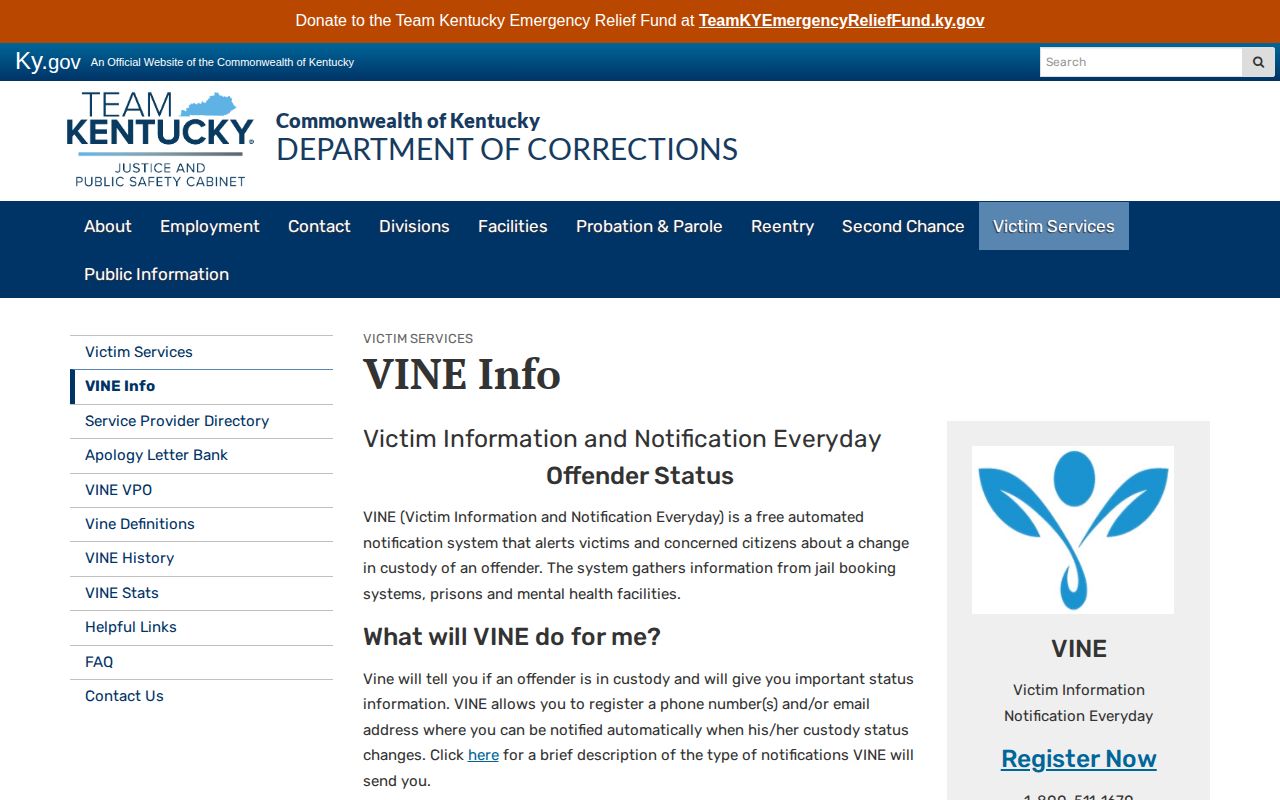
VINE may alert on a custody event, but the KDOC movement record or legal order remains the primary proof.
KDOC Released Inmate Trends
KDOC's official evidence-based-practices reports for fiscal year 2023 and fiscal year 2024 count 14,925 releases and 14,407 releases, respectively. The decline was 518, or 3.5 percent. Average active Probation and Parole population moved the other way, rising from 48,811 to 49,378, an increase of 567, or 1.2 percent. Release counts measure events during a year, while the supervision number is an average population. The measures should not be merged.
| Measure | FY2023 | FY2024 |
|---|---|---|
| KDOC releases | 14,925 | 14,407 |
| Average active P&P | 48,811 | 49,378 |
A separate Division snapshot counted 46,358 active offenders on December 31, 2025. It included 9,885 parolees, 36,434 court-placed offenders, and 39 participants in the SB 133 Women's Medical Release program. That one-day snapshot is not the same as a fiscal-year average. It does confirm that a large share of KDOC records concerns community status after an institution exit.
The snapshot also helps explain a common location error. A Probation and Parole district in KOOL represents the office responsible for community supervision, not a correctional institution holding the person. Current person status still requires a new search. Annual reports describe system movement, while the person's current detail and supporting release record answer the individual question.
KDOC Parole Release Evidence
The Kentucky Parole Board publishes a weekly hearing calendar and monthly eligibility list. Hearings begin at 8:30 a.m. Eastern, and the Board says schedules are refreshed each Monday morning. A hearing may occur as much as two months before the stated eligibility date. Scheduling shows that review is near. It says nothing by itself about the outcome or physical release.
The Kentucky Parole Board schedule page displays the public calendar and eligibility materials.
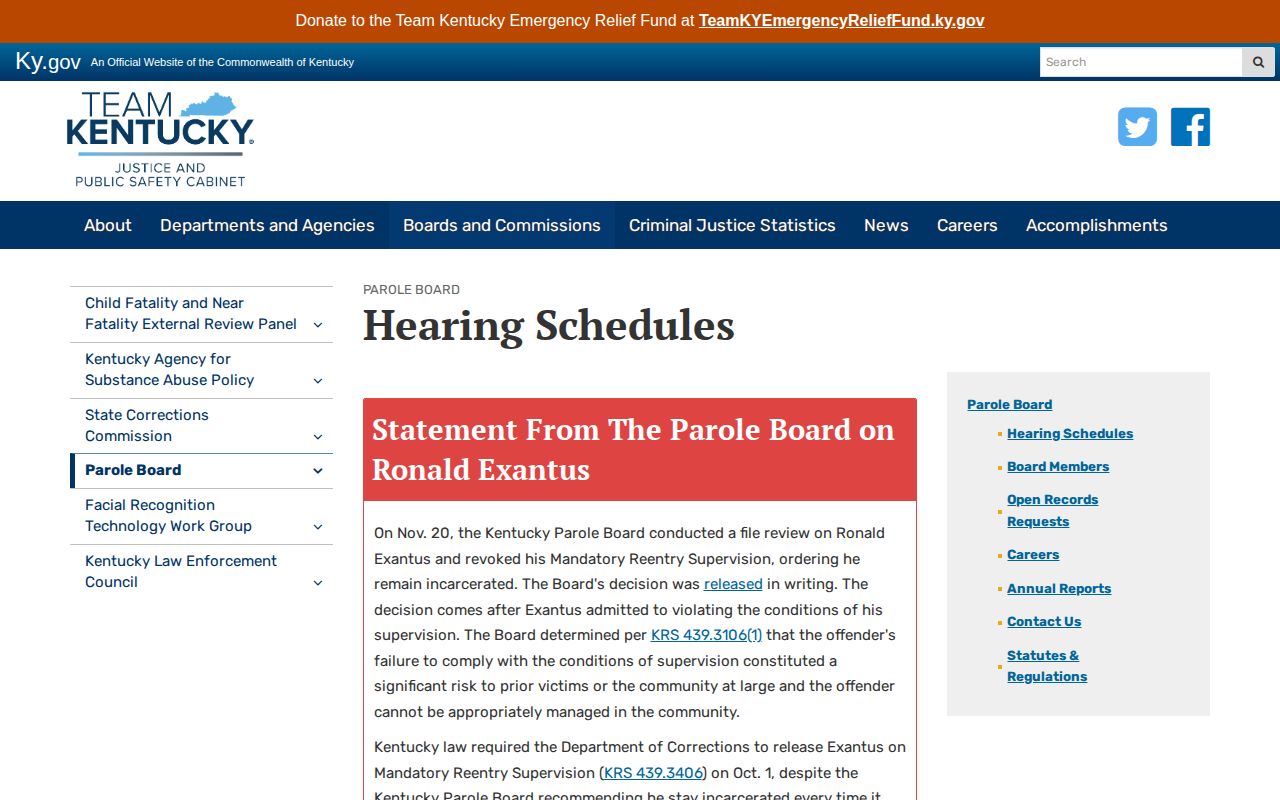
The calendar answers when consideration is scheduled; KOOL's parole table and the written Board order answer what happened.
Kentucky has no general public database of every Board decision. KOOL may show a person-specific hearing action, deferment, next eligibility date, or proposed date. A written order must be requested through the Board's open-records route when that document matters. Under 501 KAR 1:030, deferment means reconsideration after stated months, while serve-out means service through sentence completion. Neither should be rewritten as a release.
KDOC Versus County Release Records
The KDOC offender search covers state corrections cases. County jail release records cover local custody events. A state-sentenced person may be housed in a county jail and still have a KDOC-controlled release, so the physical building alone does not settle record ownership. Look for a state sentence, DOC number, or KDOC status. If the case remained pretrial or local, use the jail's movement record and the circuit clerk's court file.
| Question | KDOC route | County route |
|---|---|---|
| Typical case | State sentence, parole, MRS, or KDOC supervision | Pretrial, bond, dismissal, or local time served |
| Online lead | KOOL and Daily Releases | Current roster or local release view where offered |
| Durable proof | KDOC movement, computation, supervision, or discharge record | County movement entry and court order |
| Transfer concern | Read released-to agency or detainer | Identify receiving facility or authority |
The Kentucky County Directory provides the locality route when the person never entered the state corrections system.
The Kentucky Court of Justice records page documents the county-clerk route for trial-court files.
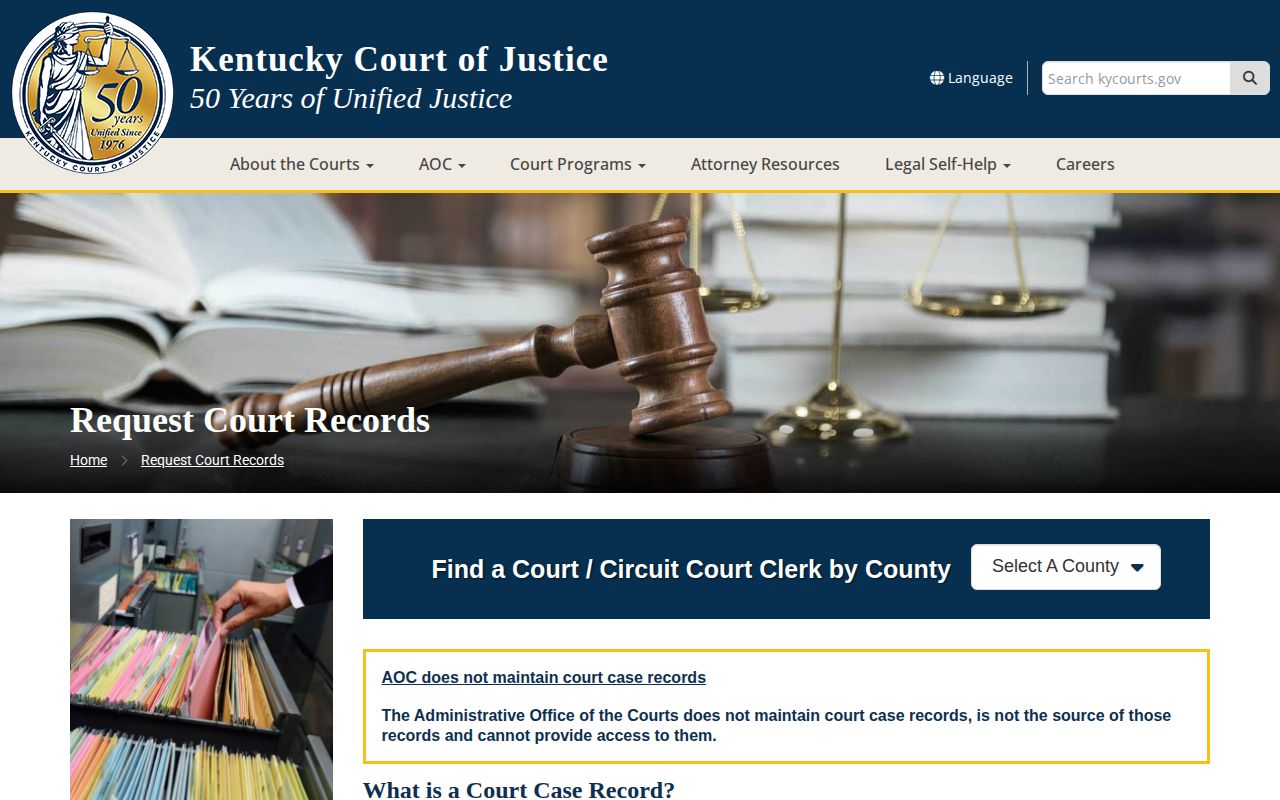
A court order can explain the authority for release, while a KDOC or county movement record establishes the operational departure.
KDOC Release Records Requests
KDOC requires a written open-records request. Email correctionsopenrecords@ky.gov and include a mailing address. The standard form is optional. Offender-record mail goes to Department of Corrections, Division of Public Affairs, Attn: Open Records Coordinator, PO Box 2400, Frankfort, KY 40602. Fax requests may go to 502-564-9575. Include full name and DOB or an offender identifier, plus the facility and approximate date range.
Ask for existing records with precise names: the release or movement entry, actual date and time, release type, released-from location, receiving authority or detainer where releasable, sentence-computation sheet, supervision begin and end record, final-discharge material where kept, and any public institutional photograph needed. Corrections-security and offender-record limits can restrict disclosure, so the Open Records Act does not make every file item public.
KDOC lists ten cents for each released paper page, one dollar for a CD plus postage, and about $2.50 for a USB plus postage. The department states a five-business-day response period under KRS 197.025. A focused request reduces ambiguity and avoids asking staff to create a new explanation.
The KDOC open-records instructions show the official channels, fees, and request details.
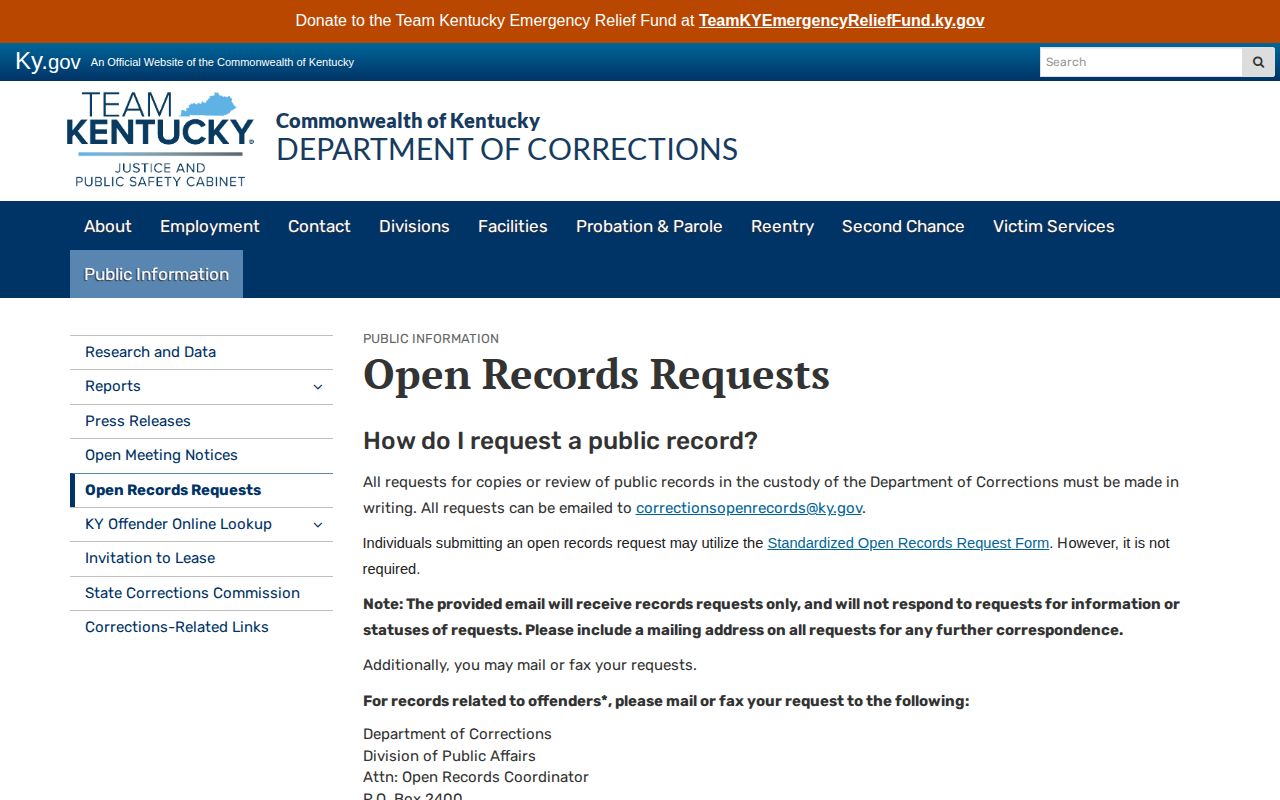
The returned record should be compared with KOOL and the dated release report, especially when status, destination, or sentence calculations appear to conflict.
Final discharge deserves a precise request. Active reporting, inactive non-contact supervision, expiration, court termination, and a Board-issued discharge certificate are not the same event. Kentucky regulation also provides that restitution can delay final discharge for a person paroled on or after July 15, 1998. Ask for the certificate or Board confirmation when completion is the question. A past supervision end date, by itself, should not be restated as legal discharge.