
Kentucky Parole and Probation
Parole and probation both allow a person to live outside a correctional institution under stated rules, but their legal sources differ. The Kentucky Parole Board decides discretionary parole for eligible state prisoners. A court places a person on probation. The Kentucky Department of Corrections Division of Probation and Parole supervises people released by the Board as well as felony offenders placed under supervision by courts. That shared supervision structure explains why either status can appear with a numbered P&P district in Kentucky Offender Online Lookup.
| Point | Parole | Probation |
|---|---|---|
| Legal source | Kentucky Parole Board release from a custodial sentence | Court order placing the person under supervision |
| Public record to check | KOOL status, parole table, and Board record | KOOL status and the order from the court that handled the case |
| Typical KOOL context | Parole with supervision dates and a P&P district | Probation (Regular), Probation (Shock), or another court-placed status |
| What it proves | Release from imprisonment under parole conditions when the release occurred | Court-directed supervision, which may or may not follow a prison term |
| Completion evidence | Final-discharge certificate or Board confirmation | Court termination, expiration, or the applicable supervision closure record |
A person can be released from a prison or jail and still have an active Kentucky sentence. Mandatory Reentry Supervision, or MRS, is another supervised prison-exit route and should not be relabeled as a discretionary parole grant. Likewise, a person whose case resulted in probation may never have served a state-prison term. Preserve the agency's wording instead of reducing all community statuses to “released.”
- Parole
- Conditional release from a sentence before final completion, authorized through the parole process.
- Probation
- Court-ordered supervision in the community, often used instead of or after a custodial period.
- Absconder
- A supervision status tied to lost contact or failure to report, not lawful discharge.
- Inactive supervision
- A non-contact level between active supervision and a later legal endpoint.
- Final discharge
- The formal end of parole authority documented by Board action and a certificate.
Verify Kentucky Post-Release Supervision
KOOL is the main statewide public route for checking Kentucky parole and probation. It is a corrections lookup, not a complete record of all local custody or every misdemeanor case. Search broadly at first. Then match more than a name, because common names, aliases, and multiple records can lead to a false match. The location field is important: a numbered P&P district means supervision through that district, not confinement inside an office.
- Open KOOL and begin with surname and first initial. Add the PID or DOC number if it is known.
- Match aliases, physical details, photograph when present, conviction county, and offense dates before relying on the result.
- Read the current status exactly. Look for Parole, Mandatory Reentry Supervision, Probation (Regular), Probation (Shock), or Pre-Trial Diversion.
- Record the supervision begin date, supervision end date, current location, and assigned P&P district.
- Review the parole-information table when the question concerns a Board action. Eligibility, deferment, and proposed release are not actual release by themselves.
- Use the official district contact list for a current conflict or request the underlying Board, court, or supervision record from its custodian.
The official KOOL gateway carries KDOC's accuracy and update warning for public offender information.
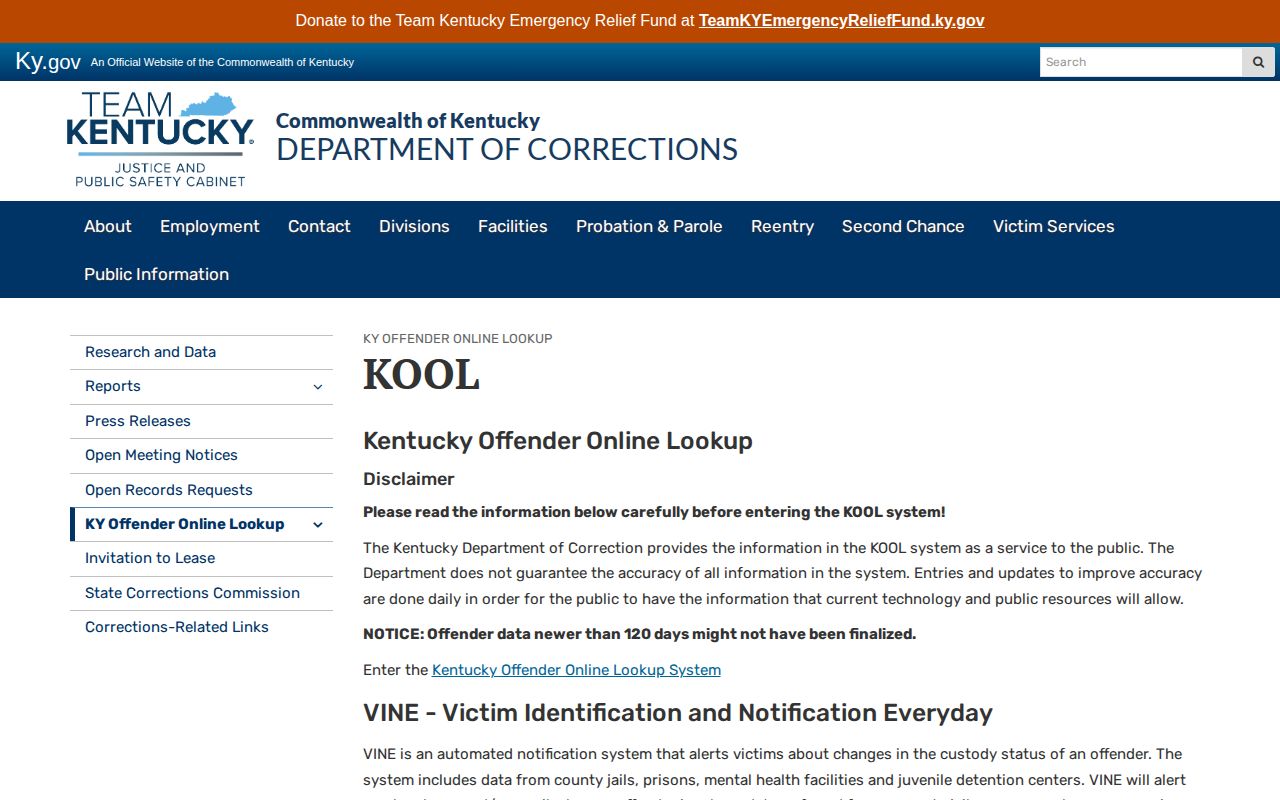
The gateway should lead to a careful match in the live application, followed by agency confirmation when recent or disputed supervision facts matter.
A county jail roster answers a different question. It may show current local custody, but a person commonly drops from that roster after release or transfer. If only local custody is known, use the Kentucky County Directory to identify the last facility and local custodian. A state-felony or KDOC record then belongs in KOOL. Federal supervision and federal custody are separate systems.
Kentucky Supervision Numbers
The Division of Probation and Parole reported 46,358 active offenders on December 31, 2025. Its published breakdown counted 9,885 parolees, or 21.32 percent, and 36,434 court-placed offenders, or 78.60 percent. Another 39 people, or 0.08 percent, were in the SB 133 Women's Medical Release program. These are a dated point-in-time snapshot, not a current lookup for a named person.
The reporting year matters when comparing supervision with releases. Kentucky's FY2024 evidence-based-practices report recorded 14,407 releases and an average active P&P population of 49,378. FY2023 recorded 14,925 releases and an average of 48,811. Releases fell by 518, a calculated 3.5 percent, while the average supervised population rose by 567, about 1.2 percent. Annual averages and a December point-in-time count measure different things and should not be merged.
The KDOC Daily Releases archive shows actual dated state release reports rather than a supervision-population estimate.
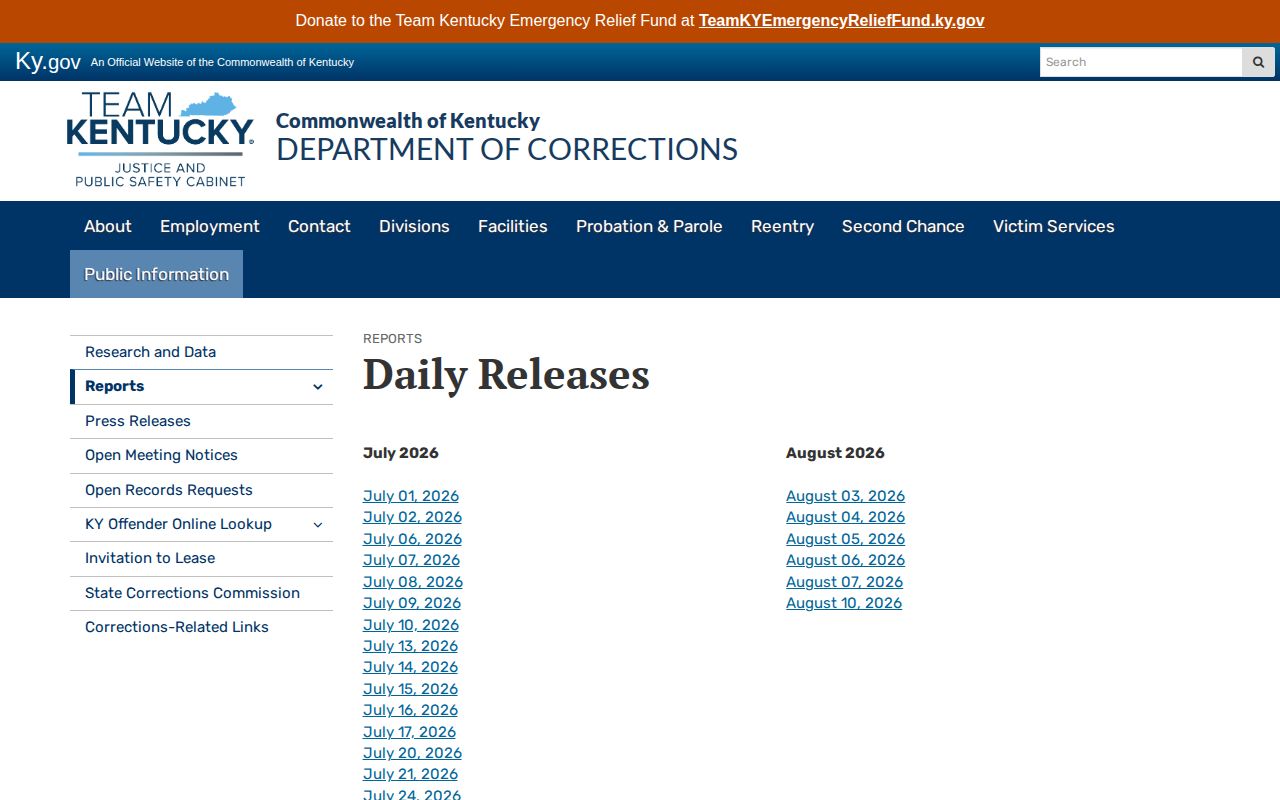
A dated release line can support the prison-exit event, while the person's KOOL status and district fields show whether Kentucky supervision followed.
Kentucky Parole Board Roles
The Kentucky Parole Board decides discretionary parole and publishes hearing schedules and eligibility lists. The Division of Probation and Parole carries out community supervision. These roles should not be blended. The Board record addresses the decision, while the assigned P&P district handles the supervision record. A court remains the source of a probation order and later court termination.
The Board's schedule is updated weekly on Monday morning. Monthly eligibility lists can show a person's name, DOC number, location, and eligibility month, and a hearing may occur up to two months before the eligibility date. Listing means consideration is near. It does not prove parole was granted, a certificate was signed, or physical release occurred.
The Kentucky Parole Board schedule page publishes the current calendar and eligibility materials.
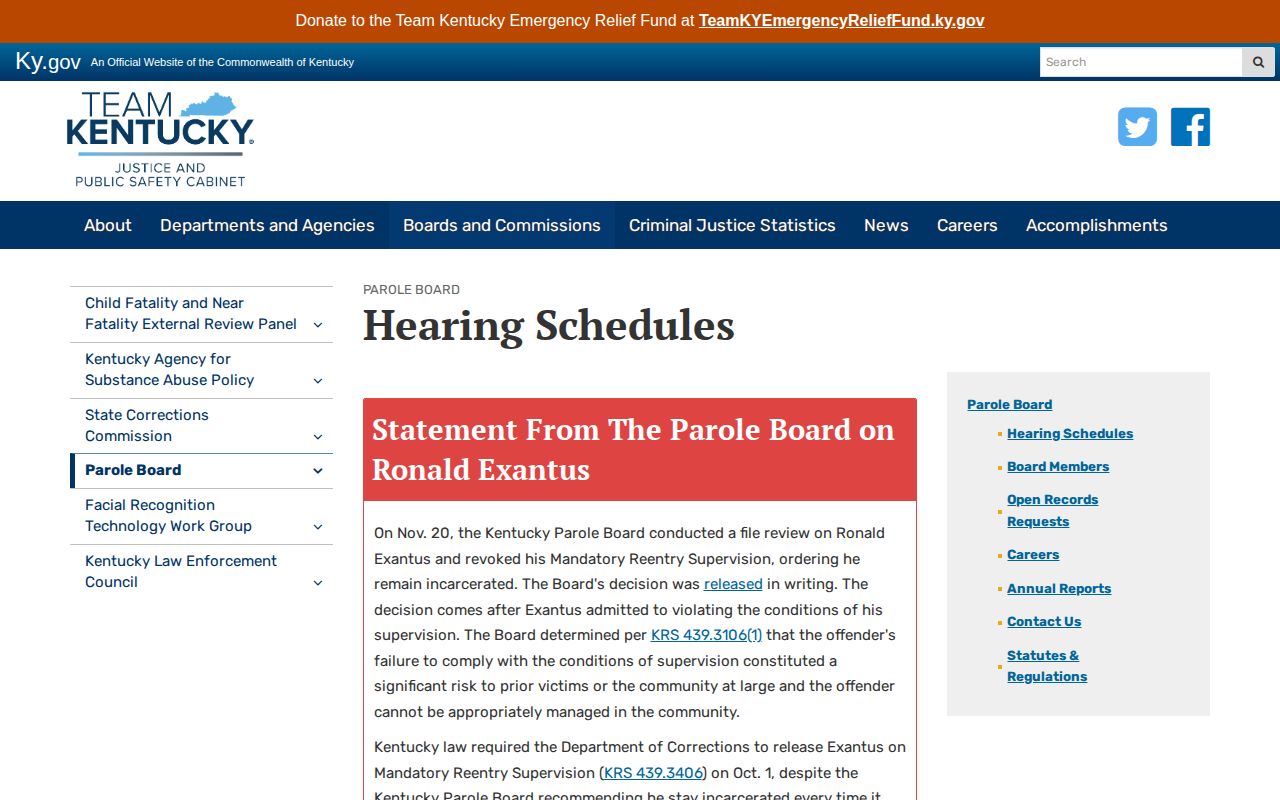
The calendar answers when consideration is scheduled; KOOL and a written Board record answer what action followed.
Kentucky supervision contacts
Kentucky Parole Board
Board information and decisions process
KDOC Division of Probation and Parole
District and supervision contacts
Kentucky does not publish one general searchable database of all Board results. Where available, KOOL's parole table gives a person-specific public view. A written decision can be requested through the Board's open-records process. The district contact list is the sound route for a current supervision question after the record has been matched.
Kentucky Absconder Status
KOOL's advanced filters include “Absconded Probation & Parole Offenders,” and an individual result may display “*** ABSCONDED ***” with an assigned district. KDOC's absconder procedure includes circumstances such as concealment of location, failure to provide a current address or report, and failure to respond to attempted contact. The label indicates a problem with supervision contact. It is not proof of lawful discharge.
An absconder flag also does not, by itself, settle whether a warrant is active or where the person is now. Do not contact or try to apprehend anyone based on a public result. Current safety or custody concerns belong with the appropriate authority. For record verification, note the displayed district and time of search, then use KDOC's district contact route. A current court or agency record is stronger than an undated copy of an older page.
Supervision conditions vary with the Board certificate, court order, and case. A violation can lead to added action, renewed active supervision, revocation, or custody, but it does not erase the earlier release event. The record must distinguish prison exit, the community status that followed, and any later return to custody.
Note: An absconder label describes lost supervision contact; it should never be interpreted as sentence completion or final Kentucky discharge.
Kentucky Active and Inactive Supervision
Active reporting, inactive supervision, expiration, and final discharge are separate Kentucky statuses. KDOC policy describes inactive supervision as a non-contact level between release from active supervision and a later endpoint, such as expiration, final discharge, court termination, death, or return to active supervision. Someone on inactive status may no longer report in the same way, yet that does not automatically mean all legal authority has ended.
| Status | Record meaning |
|---|---|
| Active supervision | The person remains on a reporting or otherwise active level through the assigned district. |
| Inactive supervision | A non-contact level that can precede expiration, discharge, court action, or renewed active status. |
| Expiration | A sentence or supervision date has arrived, subject to the controlling record and any unresolved condition. |
| Court termination | The sentencing court has ended probation under its authority. |
| Final discharge | The parole endpoint shown by Board action and the issued certificate. |
CPP 27-24-01 identifies early release from active supervision, early probation termination, expiration, revocation, and death among closure routes. Each tells a different story. Revocation can return a person to custody. Court termination applies to the court's probation authority. Final discharge from parole calls for Board documentation. A supervision end date is useful, but it should be checked against the formal closure event.
Kentucky Final Discharge Certificates
Kentucky distinguishes a prison exit from the final end of parole. KRS 439.356 states that after final discharge is ordered and the Board issues a certificate, the person cannot again be held for a violation of that parole. The certificate is therefore a clearer documentary endpoint than a past supervision date displayed without context.
Another rule adds an important qualification. Under 501 KAR 1:050, a person paroled on or after July 15, 1998 who still owes restitution does not automatically receive final discharge at maximum expiration. The Board waits for verified full payment. A record can thus show that active contact ended or a date passed while final discharge remains a separate question.
When legal completion matters, request the final-discharge certificate or obtain confirmation from the proper district or Board custodian. Preserve the precise terms in the response. “Released from prison,” “off active supervision,” “maximum date passed,” and “final discharge certificate issued” are not interchangeable statements.
Confirm Kentucky Release and Supervision
Kentucky VINE adds custody notifications, but it does not replace KOOL, a court order, or a discharge certificate. VINE receives data from jails, prisons, mental-health facilities, and juvenile detention. A state offender may have both a DOC record and a local-jail VINE record. Kentucky advises registering for both because they may generate different custody events.
Event wording matters. “DOC Parole Notification” says release on parole occurred. “DOC Parole Eligibility” signals expected Board consideration, while “DOC Advanced Release” concerns a scheduled release near sentence end. Other events can identify release by court order, home incarceration, shock probation, or a later custody change. Do not flatten these distinct notices into a single supervision result.
The Kentucky VINE information page explains the service's custody scope and registration choices.
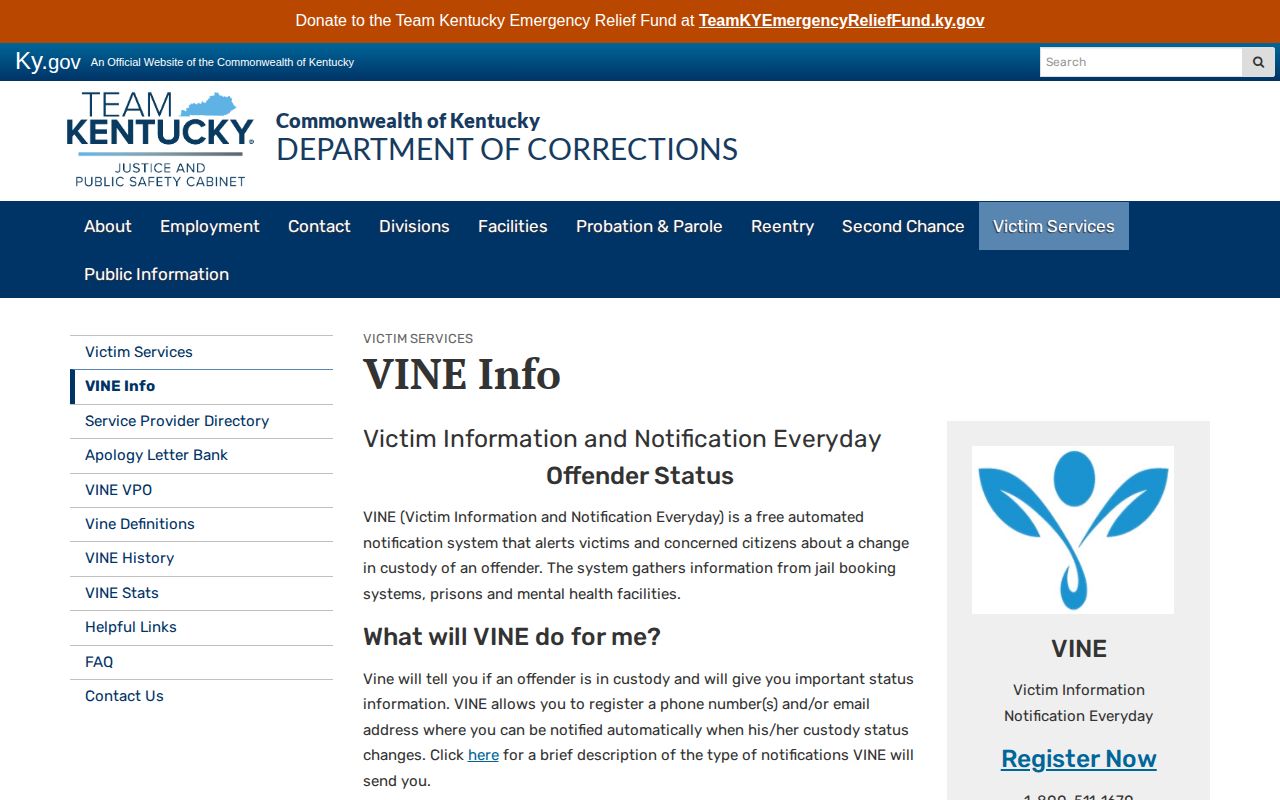
VINE can alert a registrant to a custody event, while KOOL, the Board, the court, and the assigned district remain the sources for the legal status.
Kentucky no longer provides VINEcourt registration or notifications for court cases. Custody alerts continue. That limit is crucial for probation, since the order and later court action come from the county circuit clerk rather than VINE. If the question is whether a released person is currently supervised, use a current KOOL match and the district contact. If the question is why probation began or ended, request the controlling court record.
The full statewide search and release-record path is set out on the Kentucky released inmates home page. Use it when the last custodian is unclear or when a transfer may explain why the person vanished from one roster.